The Reshoring Ripple: Impact of US Trade Policy on 2026 Procurement
As we move through 2026, the landscape of American manufacturing is undergoing its most significant structural "rewiring" since the post-war era. Driven by the One Big Beautiful Bill Act (OBBBA) and the high-stakes USMCA 2026 Joint Review, procurement professionals are no longer just managing costs; they are orchestrators of national economic resilience. This post analyzes the shift from globalized "linear" supply chains to domestic "hub-and-spoke" models, the permanent tax incentives favoring U.S. capital investment, and the critical role of precision CNC machining in securing the domestic industrial base.
3/9/20263 min read
The Policy Landscape: Section 301, USMCA 2.0, and the OBBBA
The "America First" trade agenda has shifted from a series of temporary disruptions to a permanent standing cost in 2026. The U.S. Supreme Court’s early 2026 rulings on the International Emergency Economic Powers Act (IEEPA) have forced the administration to pivot toward more targeted, statutorily grounded tools like Section 301 investigations.
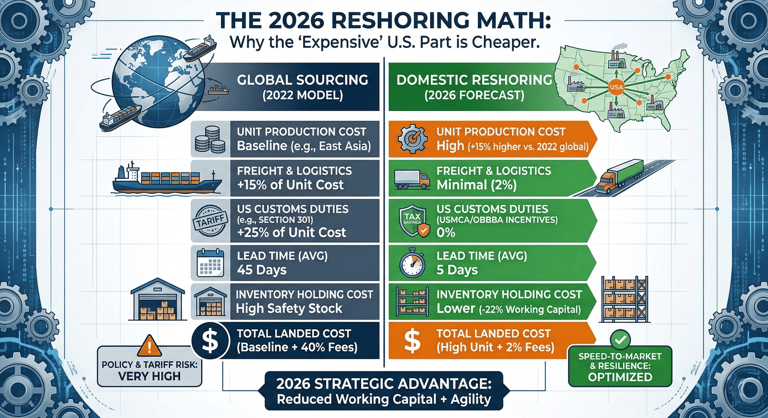
The introduction of the OBBBA has fundamentally changed the financial math for domestic expansion. By permanently reinstating 100% bonus depreciation for qualified capital investments and immediate expensing for U.S.-based R&D, the federal government has effectively removed the "tax friction" that previously made offshoring more attractive. For a procurement manager in any CNC-intensive firm , this means the ROI on a new 5-axis machining center is now significantly higher than a similar investment made just three years ago.
Deep-Dive Analysis: The "Hub-and-Spoke" Pivot
The traditional "produce anywhere, deliver everywhere" model has fractured. In its place, we see the rise of Regionalized Hub-and-Spoke Networks. In this model, the "Hub" consists of high-tech U.S. assembly plants, while the "Spokes" are Tier 2 and Tier 3 domestic suppliers located within a 500-mile radius.
This shift is a direct response to USMCA 2026 review pressures. As of July 2026, the "Joint Review" has intensified regional content requirements. To avoid a projected 6% "non-compliance" tariff, manufacturers are aggressively requalifying domestic vendors. This "de-risking" isn't just about avoiding taxes; it’s about Lead Time Compression. By moving production from East Asia to domestic corridors (like the Southeast manufacturing belt), firms are reducing transit-related working capital by an average of 22%.
Reshoring in 2026: Successes and Bottlenecks
While the policy tailwinds are strong, the "Ripple" of reshoring faces two primary domestic barriers: Labor Scarcity and Energy Constraints.
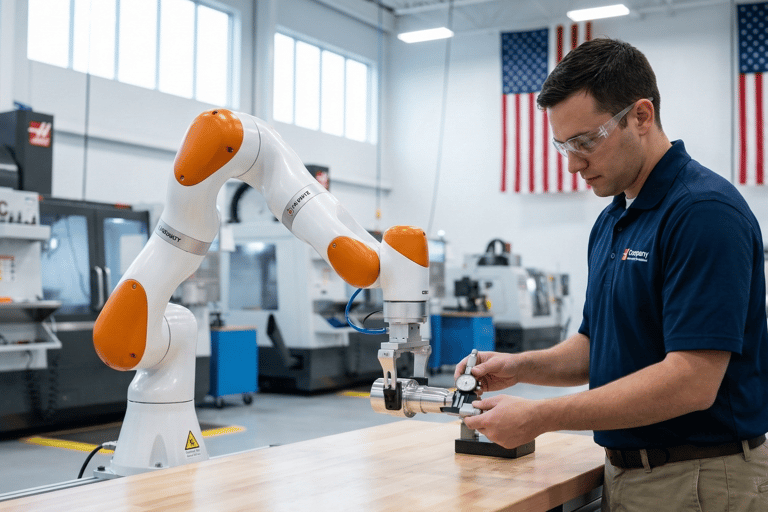
In sectors requiring extreme precision—such as aerospace and medical device components—the "Skills Gap" remains the top risk. Domestic CNC shops are countering this by leveraging the OBBBA’s incentives to invest in Cobots (Collaborative Robots) and AI-driven predictive maintenance. Procurement teams are now auditing suppliers not just on their price-per-part, but on their Automation Maturity Score. If a supplier hasn't integrated automated tool-wear monitoring by 2026, they are increasingly viewed as a high-risk liability for long-term contracts.
Strategic Outlook: 2026 Procurement Recommendations
To navigate this "Reshoring Ripple," procurement and supply chain leaders should adopt a three-pillar strategy:
Capitalize on OBBBA Provisions: Work closely with finance to accelerate the acquisition of advanced manufacturing technology. The window for 100% expensing is a competitive advantage that must be utilized now to offset potential 2027-2028 labor cost increases.
Audit for Regional Content: With the USMCA review ongoing, perform a "Deep-Tier" audit of all Tier 2 suppliers. Ensure that "Made in North America" is backed by verifiable data to avoid sudden duty spikes in Q3.
Invest in "Supplier Stability" Partnerships: Move away from transactional bidding. In a high-demand domestic market, securing "Capacity Reservations" with domestic precision machining partners is more valuable than a 5% discount from an overseas vendor.
Works Cited
"2026 in manufacturing: Policy risks and opportunities." Grant Thornton, 12 Jan. 2026, www.grantthornton.com/insights/articles/manufacturing/2026/2026-manufacturing-policy-risks-opportunities.
"US International Trade and Investment: Key Shifts in 2025 and What Businesses Should Know for 2026." Morgan Lewis, 14 Jan. 2026, www.morganlewis.com/pubs/2026/01/us-international-trade-and-investment-key-shifts-in-2025-and-what-businesses-should-know-for-2026.
"The USMCA and the road to shared prosperity in an era of transformation." Brookings Institution, 4 Mar. 2026, www.brookings.edu/articles/the-usmca-and-the-road-to-shared-prosperity-in-an-era-of-transformation/.
"The resurgence of American manufacturing." BOK Financial, 21 Dec. 2025, thestatement.bokf.com/articles/2026/01/resurgence-of-american-manufacturing.
"Global Value Chains Outlook 2026: Orchestrating Corporate and National Agility." World Economic Forum, 23 Jan. 2026, reports.weforum.org/docs/WEF_Global_Value_Chains_Outlook_2026.pdf.